Process: The Project
Although some schools of literature rather look down on erasure poems, they actually have an interesting and erudite history.
“Poet Erin Dorney identified six styles of erasure poetry: blackout; crossout, crossing out words to create a new poem; computer, using computer software to add or remove lines; cut out, using a knife to cut words out of paper; covered up, covering up the original text with another material (paper, sand, rice, etc.); and retyped, retyping the original text to make it look like a conventional, traditional poem, leaving space where the original text used to be.
An early appearance of erasure poetry was in 1965 when artist and poet Doris Cross created “Dictionary Columns,” in which she used painting and drawing on a dictionary to create poems. Other examples of erasure poetry include “Freeland: An Erasure” by Leigh Sugar; renowned poet Tracy K. Smith’s poems “Declaration,” which stems from the Declaration of Independence, and “The Greatest Personal Privation,” from notes and letters about slave-holding; and M.NourbeSe Philip’s Zong!, which uses court documents about the 18th-century slave ship that threw more than 120 enslaved Africans overboard in order to collect insurance money. [Source: Poetry Foundation].
But one of my favorite erasure poets is Tom Philips. His manuscript A Humument is his treatment of “A Human Document”, a small yellow Victorian novel by W. H. Mallock. Phillips began “treating” the book with “painting, collage, and cut-up techniques” that obscure a majority of the original words. At first Phillips “merely scored out unwanted words with ink leaving some (often too many) to stand and the rest more or less readable beneath rapidograph hatching.” Over time, his methods evolved and became more in-depth, even going so far as to collage a photo of Mallock’s grave onto one of the pages. He employed numerous methods, but all of those methods focused on adding something over physically removing part of the book through erasing. The book became his lifelong treatise, with many pages reworked republished.
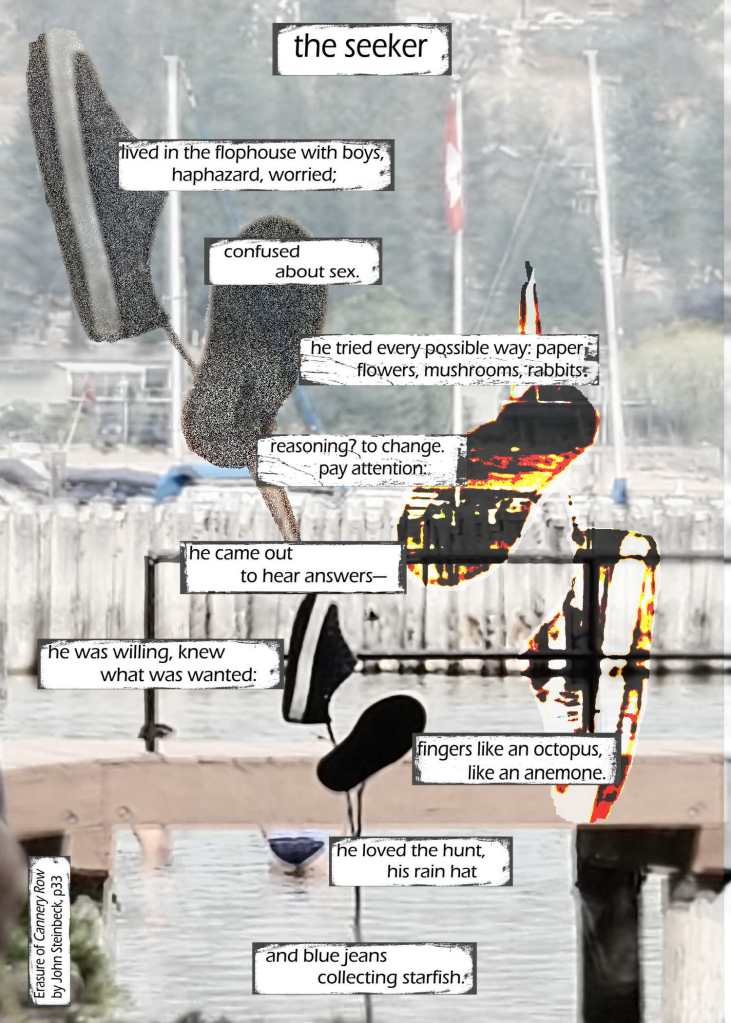
My piece “the seeker” is part of my hybrid manuscript entitled: ‘Little Fish, Uncanned’ which is a response to ‘Cannery Row,’ by John Steinbeck. Each poem is an erasure of one single page of this brilliant novel, with each poem placed on a background of my original art, whether digital photo-art or some other medium.
Process: Erasure to Find the Poem on Page 33
Through the process of whittling away the forest to reveal the tree, the poem reveals itself to me.
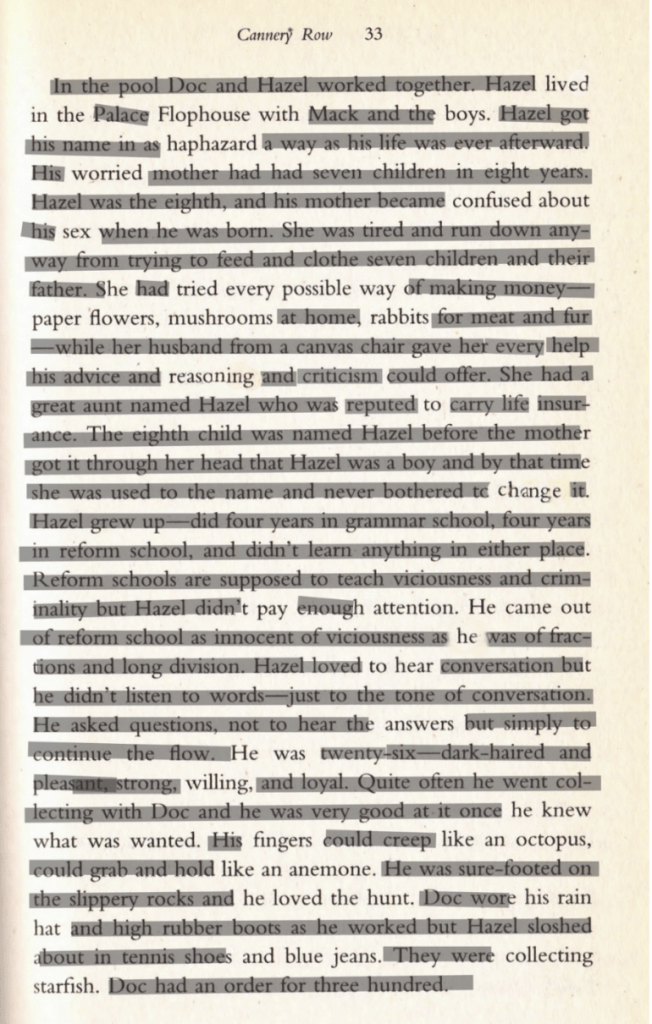
Process – The Poem
Once the poem has revealed itself to me through the process of whittling away the forest to reveal the tree, I write it out as itself, seeing how its presence should look upon the page. In the instance of “the seeker”, the poem also reveals a process: the process of finding out who one really is, the process of search and revelation.
the seeker
erasure of Cannery Row
by John Steinbeck p.33
lived in the flophouse with boys,
haphazard, worried;
confused
about sex.
he tried every possible way: paper
flowers, mushrooms, rabbits—
reasoning? to change.
pay attention:
he came out
to hear answers—
he was willing, knew
what was wanted: fingers
like an octopus, like an anemone.
he loved the hunt,
his rain hat and blue jeans
collecting starfish.
Process – The Artwork
Once the poem’s complete, I decide what artwork will work best as its background, whether art from scratch or a collage of my own photography, which I then modify to suit the topic.
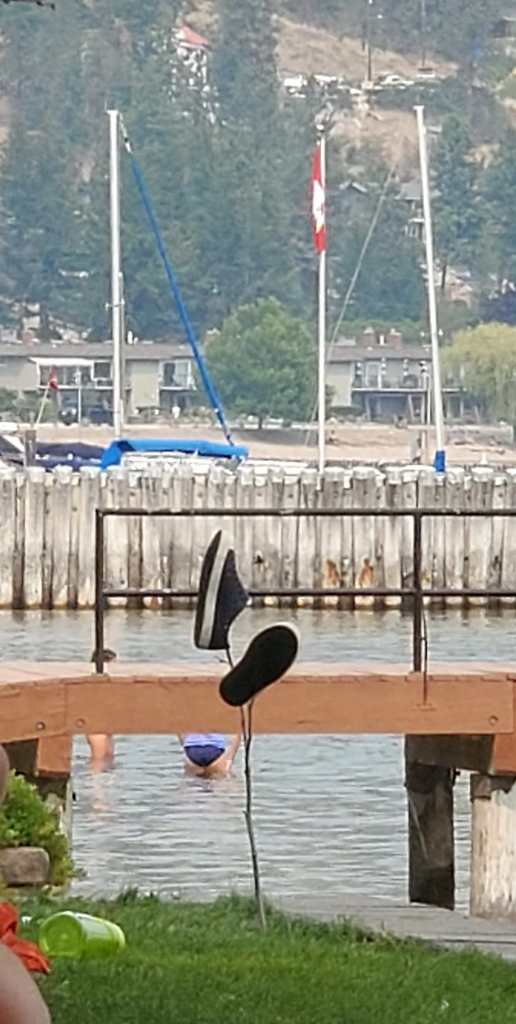
In this case, I decide to go with a photograph which includes a pair of sneakers someone randomly stuck on some sticks – a perfect metaphor to me for a journey. I dabble with various digital tools to develop and move each piece wherever it is leading, but I never use Photoshop; I prefer a more organic approach.
Once I’m satisfied with the artwork and the size is adjusted to suit, I paste in the lines of the poem.
the seeker : an erasure poem by kerry rawlinson
LITTLE FISH, UNCANNED – a downloadable PDF version of kerry rawlinson’s creative notes on an erasure poem from John Steinbeck’s Cannery Row:
kerry rawlinson is a mental nomad & bloody-minded optimist who gravitated from sunny Zambian skies to solid Canadian soil. Winner of New Millennium Writings, Canterbury and Princemere Poetry Prizes and the Edinburgh Flash Fiction Award, kerry’s also placed in several poetry contests, e.g. Bournemouth; Wells Open; Bridport; CV2 Poetry Prize; Room; Palette; National Poetry Society, and more. Recent publications: Consilience Journal; Broken Spine Anthology; Novus Literary; Common Ground; PrimeNumber; The Ex-Puritan; Grain; Pinhole. kerry’s enthralled with the gore, music, brutality & beauty of the world, exploring its edges in her work. She wanders barefoot through dislocation & belonging—and still drinks too much (tea). kerryrawlinson.com @kerryrawli
 IceFloe Press