Greek Ode (I)
On Halki for a week all is inter-connected. The morning smell of
bread merges in the evening with the
taste of wine on the terrace. The plump olive
glides across a nipple as we kiss on
the beach and the sheets are sweet
with semen as, freshly showered, we
make love a third time as the night
approaches. The gold of honey gleams
on your skin; I lick it passionately, slowly,
in a circle. The hair around your genitals
is yellowly fragrant of figs, which
you gather on the way back while I
among the stones and thistles pick thyme,
and all day long my hands reek of sex.
Tanned by the sun, my body, again in
love with yours, is pulsating, desire
mirrored in my mind, and for the first time
ever I feel confidently, dizzyingly
sexy! We trade glances like the sea and
the horizon; like aroused satyrs we go
into the water to cool our erections.
In the midday heat I drink (word-
lessly) the blue of the billowing surface
as the souls of the dead fly into the sky
from the graveyard across the bay.
With you my restlessness stands for a moment
still; time darts backwards and forwards, and
life is embraced lovingly in death.
The Impotence of Language
For years it waited trappedbehind a wall only to finally
spill out, to scrub the silence
from every pore by writing, to
break into confession for its own
salvation, to wash the unsaid
in the words of a poem.
I am struck by a sentence in
Slovenian, and again by another
in English, only differently,
which leaves me at a total loss.
And at times I don’t know anymore
where I stand when feeling is
translated into language by thought.
And I don’t know anymore what
language I love you in. Angelically
you complain that it’s taking me
away. You stand alone, helpless at
the door, as I lock myself in the
chamber of my stories, where you
have no entrance to my words.
I lie beside you, you nibbling at
my nipple, strange things roaming
through my head in different languages,
and already your lust is erect again.
I often think that sex is all you
want me for. But when I give
myself to you in bed I come
undone. Calmer, I conclude:
the impotence of language
leaves me in confusion, but this
communication of bodies
needs no dictionary.
Greek Ode (II)
Pagan Apollo touched me with his finger ofapproval and something almost unbelievable
happened – I am discovering my body,
which like a poem has become a space of oppor-
tunities you can turn to your advantage or abuse.
I was taught as a child that nakedness is shame.
In their catechisms everything bodily was con-
nected to disgust. But him I nonetheless allow to
spread me across the rocks in the water and shoot the
erections in our film without the least embarrassment.
At night jealous Zeus sends the bora to shake the old
house, and in the morning after making love we wake
with laughter. Crumpling the bundled sheet in my hand,
I notice we are covered in particles of plaster,
which sprinkled on the bed from the Greek ceiling above.
Bouquet of Cracks
All weekend I tidy the clutterby myself, kitchen to dining room
and beneath the hall stairs.
I rummage through the cupboards
and into a bin bag go herbs and
spices with use-by dates long ago
expired. I have no idea what to do
with the plastic cartons and glass
jars he so religiously collects.
All this junk piles up relentlessly.
Hangs around my neck, chokes me,
and I don’t know how to save myself.
He prefers to do other things. The things
that would make me happy are for him
a waste of time. I notice the thin cracks
in the wall just below the ceiling. Our
house, it seems, is settling. By the time
he gets home I am cranky and
lonely and push him angrily away.
Like a boat from the shore. Until
he’s worn out and fed up. He keeps to
himself a few days, and I sense that
something inside him has shattered.
For days we avoid the unstated accusations
until they burn beneath the skin and stale
silence gnaws at us. This time he clearly
is not giving in. In a panic I look for ways
out and am so frightened I can hardly
breathe. Wednesday night waiting for me
on the table is a bouquet of white lilies and his
note: These are for you! Beside the vase,
a knife. My hand is shaking as I take
the wet blade; something hard
inside me has finally broken.

Greek Ode (III)
I lie in the sun at home on the terrace andgratefully my skin remembers the sand-
storm last summer on Halki: we closed the
shutters and in the idleness of afternoon
made love in the shade of summer heat.
The boatman’s house gives shelter and
the bed creaks along with the roof beams.
My sunburnt body is afire and with
genuine delight I am intently aware of it.
Awestruck I gaze at the nakedness of our
love without a hint of shame. Even he
tells me: “You are sexy, so very sexy . . .”
After we come we will doze a while and rise
when night has fallen. But this inloveness will
not leave me. And comes back to me today
on the terrace, so that in the big city I recall
the round stones, the thistle, the song of the
cicadas and the color of the Mediterranean sky . . .

The Slovenian poet Milan Šelj has lived in London since 1992. His first poetry collection, Darilo (Gift), was published in 2006. Four other collections have appeared since: Kristali soli (Crystals of Salt) (2010), Gradim gradove (Building Buildings) (2015), Slediti neizgovorjenemu (Tracing the Unspoken) (2018), and Jezik je ključ (Language Is the Key) (2023) – all published by ŠKUC-Lambda in Ljubljana. Tracing the Unspoken, translated by the author and Harvey Vincent, was published in 2019 by A Midsummer Night’s Press in New York.
Selections of his poems have appeared in translation in a number of anthologies and magazines – in the United Kingdom, Croatia, North Macedonia, Italy, Israel, and Portugal. He has had readings and participated in poetry festivals in the UK, the United States, and Sweden. Additionally, along with other authors, he has presented Slovenian LGBTQ+ literature at events in Berlin, Sarajevo, Lisbon, and Cyprus. He also writes for children, having published two illustrated collections of children’s poems: Kosmatice (Zala, 2020) and Rime na veter (Rhymes in the Wind) (Založnistvo tržaskega tiska, Trieste, 2024), the latter of which was shortlisted for the Kristina Brenk Award for Best Slovenian Children’s Book of 2024.
He has also translated, into Slovenian, a book by the Croatian poet Romeo Mihaljević (Do mraza, Aleph, 2022); other translations of his have appeared in the ŠKUC-Lambda anthologies Moral bi spet priti (2009), devoted to contemporary European gay male poets, and Brez besed ji sledim (2016), devoted to contemporary European lesbian poets.
The photograph of Milan Šelj is by Robert Taylor.

Photo (c) Dušan Šarotar
Rawley Grau has been translating literary works from Slovenian for over twenty years, including poetry by Milan Šelj, Miljana Cunta, Miklavž Komelj, Janez Ramoveš, and Tomaž Šalamun, among others. His prose translations include novels by Dušan Šarotar, Mojca Kumerdej, Sebastijan Pregelj, and others. His translations of Šarotar’s Panorama and Billiards at the Hotel Dobray were shortlisted for the Oxford-Weidenfeld Translation Prize. He is currently working on translations of a volume of poetry by Aleš Debeljak and a novel by Ana Schnabl. In 2021, he received the prestigious Lavrin Diploma from the Association of Slovenian Literary Translators. His translations from other languages include A Science Not for the Earth: Selected Poems and Letters (Ugly Duckling Presse) by the Russian poet Yevgeny Baratynsky, which received the AATSEEL prize for Best Scholarly Translation, and The Long Coming of the Fire (Deep Vellum), a volume of poems by the modernist Macedonian poet Aco Šopov, co-translated with Christina E. Kramer. Originally from Baltimore, and formerly resident in Toronto, with brief sojourns in Leningrad and Nashville, he has lived in Ljubljana since the early 2000s.

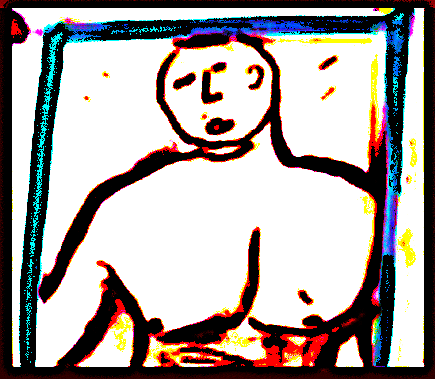
Art works: Man at Window (a drawing), Seaside collage shards (c) 2024, Banner: Man at Window /Collage (c) 2024. Robert Frede Kenter.
Robert Frede Kenter is a widely published writer, visual artist & EIC/Publisher of Ice Floe Press. Robert has a new book, FATHER TECTONIC, forthcoming Feb. 2025 from ETHEL ZINE Press.
 IceFloe Press