Solastalgia
The Sunset
Golden light pours down through the alleys of Fargo at sunset. The prairie’s big sky is concentrated and contained by the rivers of concrete and riverbanks of garages. Rivulets, arteries. As the day is bleeding out in a final overflow of light, the end is the beginning, and the beginning is the end. It stays light until 10 PM; kids can be heard playing in the street on their summer vacations even as I am trying to fall asleep. Transition adds layers of color, beautiful nuance, magical liminality where things that weren’t possible at high noon have space to manifest.
I miss home, but home is gone. Not for any existential or philosophical reason, but because my town was above water one day, under it the next. Gone in the most literal sense. And in that way, perhaps it isn’t home I miss, but something that suddenly no longer exists and has no hope of coming back. What I miss is not the past, but a present and future that won’t unfold like I’d imagined.
The Sky
I lived in a beautiful place, though many would not call it so. You could see so much sky that you knew your place under the cosmos. More to the point, you knew you had a place in the cosmos. What else was there to look at but sky and grass, whose endless gradients and variations changed depending on the light, wind, time of year, weather? Storms approaching were seen from miles away, not catching me unaware in this new city without an umbrella, walking between buildings that shut out the sun and sky. It wasn’t just the expanse, although that was certainly part of it. It was also the minutiae – the training of the eye to scale to notice the tiniest details. Tiny wildflowers in endless rolling hills of grass and cattle. Butterflies on those flowers.
I remember running down the gravel road outside my childhood house, trying to disappear into that vast blue prairie sky. It looked close enough to touch, and I believed if I walked, and then ran as fast as I could, I could touch the horizon. Eventually, when that didn’t work, I flapped my arms to try to take off in flight. But as far as I ran, and as fast, the horizon just remained lofty and unattainable, a paradox of getting farther away the closer I thought I got. I would turn back and walk home, to the house that looked like a desert island on a sea of undulating grass, and small hills that rolled like waves. Childhood was like living on a desert island in so many ways.
Once, during the rare times a man I was seeing came to visit, we walked in what felt like a vast steppe. He thought we could see nothing all around us. Looking down, we saw a butterfly whose wing had been caught in a thistle thorn, and I gently freed it. We watched it fly away. In the distance, horses drank from a stream.
He said it was expensive, and difficult, to get flights to where I lived. Connections, regional airports, hours of driving from the nearest big city hub. So he didn’t come very often at all.
The City
I turn back toward the fire escape and scale the three flights to my loft apartment in the converted brick fire station. Twilight waning, I turn on my booklight and read the book Paul lent me, about the Paleozoic era in North Dakota. The beginning of the fossil record here, when North Dakota was close to equator. I picture it – tropical, sweltering, murky with seas receding and returning. I imagine the continent drifting, drifting, and like magnetic poles changing, North Dakota now dry, landlocked, with fierce winters. An Ice Age inexorably inched toward them, but did the sea and bedrock know it when they were baking, marinating in tropical sun and humidity? Not much has changed – my life still often feels like living on a desert island sometimes.
The Red River of the North
The river. It curves and meanders more than any other I’ve seen – maybe it’s enjoying the view. Maybe it can’t decide which direction to go, and is constantly changing tack. Maybe these two phenomenon are one and the same in the river’s case. It flows north, propelled onward by its own momentum, or pushed by rain, or invited by opportunities in the landscape – a blend of will and fate, as we are all products of our environment, and exert pressure by our motion. Something about its northward flow, about North Dakota’s prehistoric northward drift, endears me. It seems against gravity, or at least drawn to the remote and isolated, the wild and the quiet.
It used to be a lake at the end of the last Ice Age, formed by melting Wisconsin glaciers. As the glaciers retreated, the water spread. When it floods due to heavy rains or ice melts, it fills up the lake-bed it used to be. Like the Silurian Sea, expanding and contracting, or a moon waxing and waning, it is itself and its former self at the same time, like us.
Paul
After he and I broke up and then, I lost my town, I moved to Fargo. Then, the world went into quarantine. Paul became my first friend in the city. By this point, I was finally telling people about my autism pretty quickly, off the bat, to reduce misunderstanding.
One thing about Fargo – people are friendly, or kind of. Probably because being surrounded by so many people makes us feel lonely when we realize we aren’t talking to any of them. Paul started up a casual conversation with me one day at the local park last fall, and that conversation just kept going with breaks in time, but not in flow or substance. Paul can pick up conversational threads weeks later, as if only a few seconds had passed, and we were still talking the same topics.
In spring, we crossed over the river to Moorhead on the Minnesota side. Paul is a fossil hunter. He is comfortable with the past. The submerged, to him, is as valid as the present and the future. He wanted to see the natural history museum to get inspired for a couple of public and private digs he was planning for the summer. He wanted me to come with him for someone to talk to about the significance of each find, I guess. That’s the thing about Paul: he’ll talk about random things as if they’re as natural as the weather, and I guess they are. I was content to listen to him talk. In fact, I was grateful to not feel the pressure to form words in a logical, socially acceptable sequence, although I was listening, and would sometimes comment, hours, days, or weeks later. Other people’s special interests suited my brain’s wiring completely, a relief to have someone who didn’t mind skipping small talk or bland pleasantries.
“You should come visit me out in Medora this summer,” Paul said. I didn’t reply, but he was used to that. He couldn’t prise my hometown or my relationship out of that dry, rocky ground like he could coral imprints or fossilized fish that appear like daguerreotypes on rocks. Still, there’s a part of me that wants to think he believes it could be done – someday. That he at least holds it as a possibility.
He took a long time going through the museum. I was content to stare out the window at the river. He didn’t mind, or even ask why. He knew I’d tell him if I wanted. I was looking at the Hjemkomst Viking ship next door. The middle of a vast continent, in a landlocked Plains state, seemed an odd place for a Viking ship, stoically positioned against an ocean of wheat and soy fields. But the river was rushing with spring snowmelt, and I imagined the ancient lake filling to its former glory, with me sailing the ship on it.
Or, riding the rushing, icy runoff to Lake Winnipeg, and then, on to Hudson Bay, and from there, all the way to Norway.
I’d show up with the ship, whose name means “homecoming,” and say to it, “now you’re home.”
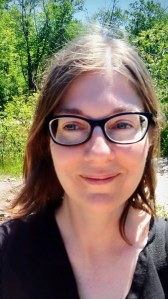
Margaret King’s recent work has appeared in Memoir Mixtapes, Petrichor, Highland Park Poetry, and Bone Parade. She teaches tai chi in Wisconsin. She is also the author of the poetry collection, Isthmus. SM: Twitter: @Indreni Bluesky: @Indreni
IG: Zorphie
Art Banner: Glancing Backwards/Forwards (in the slats of a late dawn). A Vispo by Robert Frede Kenter (c) 2024.

